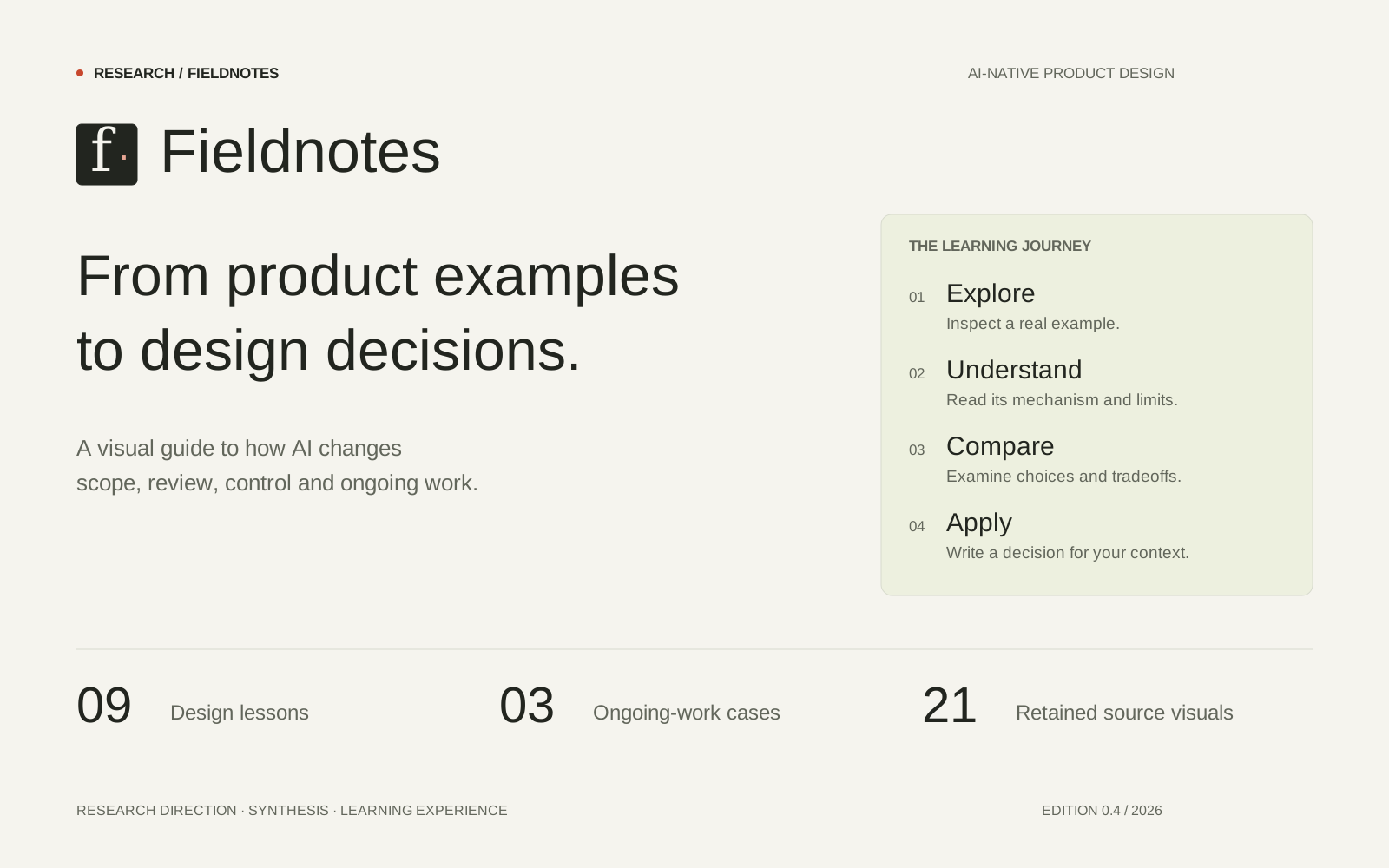
Stage 01 · Ambiguity
When does an example become a defensible decision?
A polished product example can suggest an interaction while leaving its most consequential behavior outside the frame. A review button may be visible without showing what is approved. An activity list may show progress without demonstrating how someone resumes the work tomorrow.
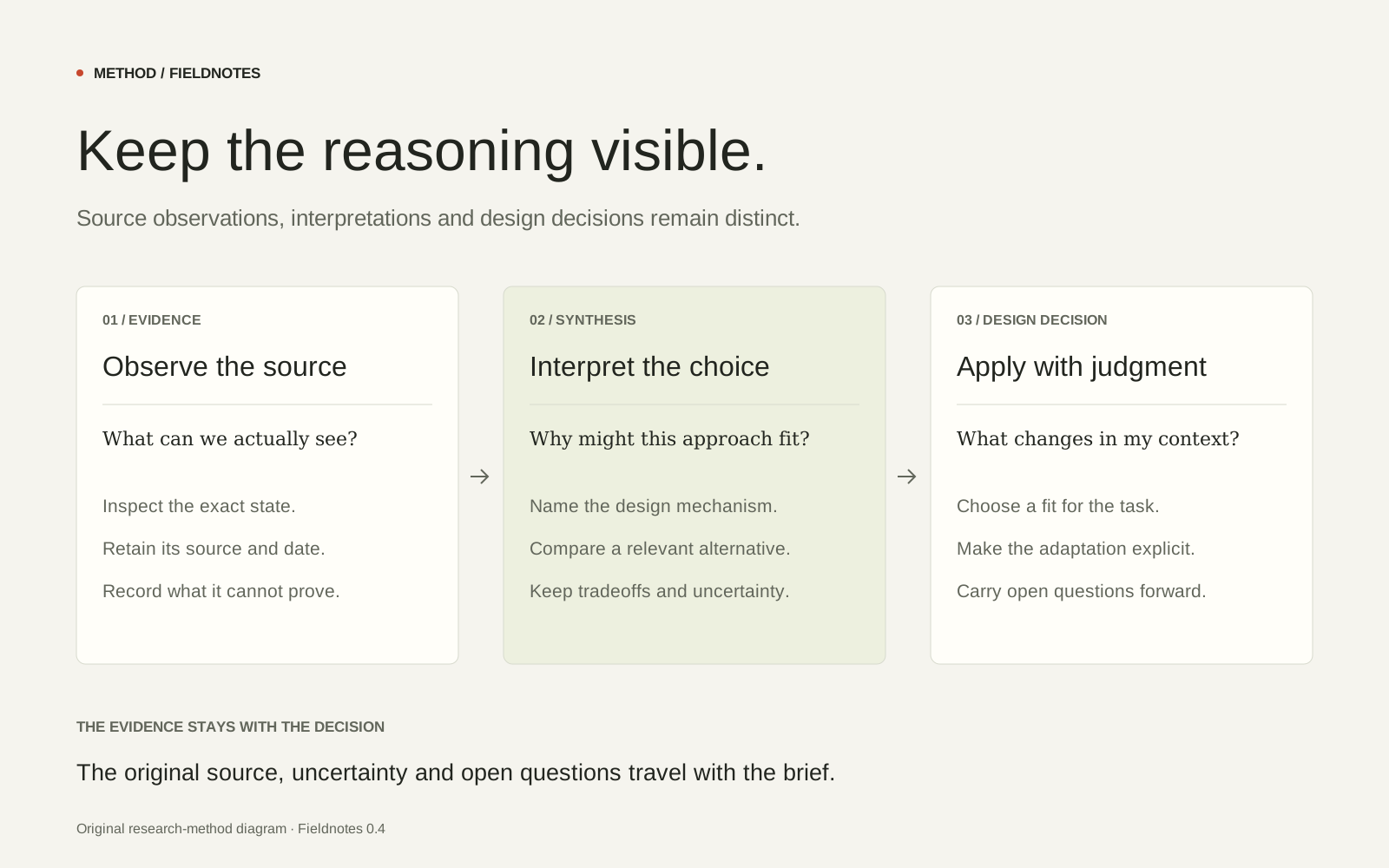
Fieldnotes connects what a source actually shows to a mechanism, the conditions in which it could fit, the tradeoff it introduces, and a question to test. The aim is to make a reference useful beyond the product or visual style that first inspired it.
Stage 02 · Structure
Follow the evidence into the decision.
The work combines desk research, close visual analysis, comparison across products and research synthesis. Earlier source collections were reconciled with the guide’s current records to preserve useful examples and identify gaps for fresh investigation.
Each reference retains its source and exact visual state. The analysis separates visible observation, interpretation and behavior still needing verification. A product illustration, an edited demonstration and an independently observed task support different claims.
From there, the reader decides what to preserve, what to adapt, and what to investigate. A code review may suggest keeping an explanation beside an inspectable change. Transferring that idea still requires choosing the right unit of review: a sentence, a record, an amount or a consequence.
Stage 03 · Prototype
Three decisions that shaped the guide.
Organize around the designer’s task
The nine lessons address decisions such as defining scope, reviewing a change, setting authority, correcting a proposal, recovering state and returning to work. Product examples sit inside those questions, allowing different interfaces to be compared without treating visual similarity as proof that they solve the same problem.
Make the tradeoff part of the lesson
Object selection can make intent precise while missing context elsewhere. A checkpoint can offer a restoration target while leaving external effects unresolved. A named assistant can create a recognizable place to return while obscuring which artifact contains the authoritative result. These tensions give designers something concrete to investigate.
Let research become a working brief
Readers can select relevant references, compare approaches and record decisions for their own task. A saved, exportable brief carries an evidence appendix, keeping the rationale and its limitations close to the proposed design.
Stage 04 · Evidence / Latest chapter
Beyond the Assistant
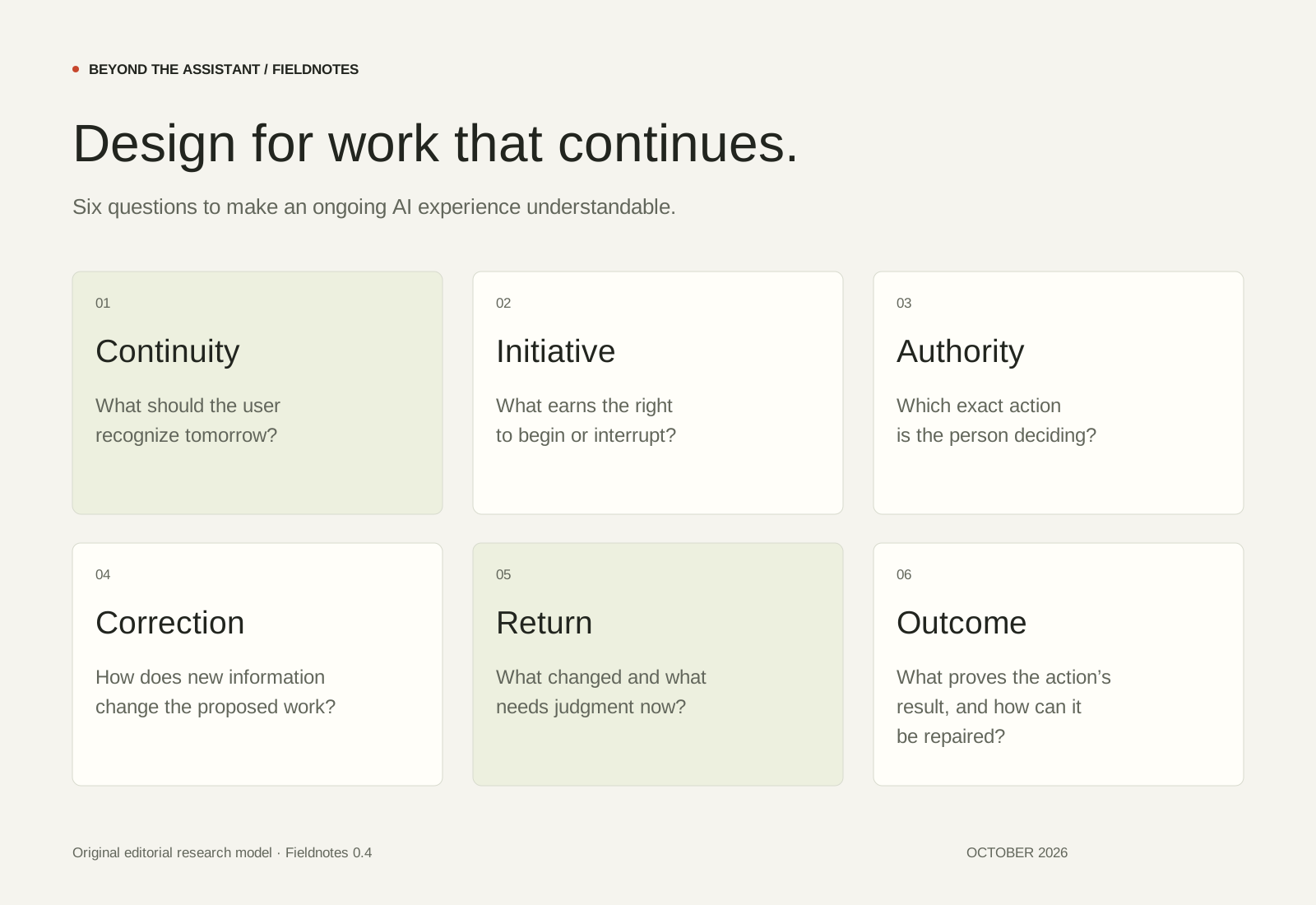
The latest chapter examines work that continues across time, decisions and surfaces through OpenAI Dots, Grok Bot and Muse by Meta. Six editorial questions guide the comparison:
- Continuity
What should the user recognize tomorrow?
- Initiative
What earns the right to begin or interrupt?
- Authority
Which exact action is the person deciding?
- Correction
How does new information change the proposed work?
- Return
What changed and what needs judgment now?
- Outcome
What proves the action’s result, and how can it be repaired?
Dots · Keep prepared work inspectable
Published launch examples place a review request and proposed fix beside a work surface, and show revision after a changed requirement. They suggest keeping judgment close to a specific result; completed merge or publication remains outside the evidence.
Grok Bot · Bind permission to a defined scope
An incident example exposes a proposed batch, exclusions and exact message before authorization. The lesson connects permission to the work it covers, with a separate need to establish what happened afterward.
Muse · Give continuing work recognizable places
Goals, activity, checkout approval and artifact previews answer different return questions. The published images concern different tasks, so their connection is a research question rather than an assumed continuous journey.
The chapter adds seven visual assets and reuses two existing Muse references. Revisiting a source preserves the research history; it does not create an independent observation.
Stage 05 · Story
A learning journey that ends in a decision.
Explore → Understand → Compare → Apply. The interactive guide brings traceable references, focused comparisons and an editable brief into one experience. Maya, an illustrative exercise, rehearses correction and review before publication. The latest chapter adds prompts for standing responsibility, authority, retained context and recovery.
- 09
- Design lessons
- 03
- Additional ongoing-work cases
- 21
- Retained source visuals
The delivered work is a working guide and portable research package. The latest edition extends the lessons while preserving previously saved work. These counts describe the artifact’s scope.
Recorded guide checks covered source consistency, saved-work preservation, brief assembly, navigation, image inspection and desktop and narrow layouts. They establish qualities of the guide, not authenticated end-to-end testing of the researched products. Effects on designers’ judgment, review effort and downstream product outcomes remain unmeasured.